
If you've ever experienced mysterious stringing, popping sounds during printing, or parts that snap way too easily, there's a good chance moisture is the culprit. Filament absorbs water from the air, and wet filament causes problems that are frustrating to diagnose and even more frustrating to fix.
The solution? Store your filament dry in the first place.
Here's my complete setup for keeping 24 spools bone-dry and ready to print at a moment's notice.
Why Moisture Destroys Prints
Most 3D printing filaments are hygroscopic—they absorb moisture from the air. PLA does it gradually, PETG does it faster, TPU and nylon will soak up humidity like a sponge. Even filament that arrives vacuum-sealed will start absorbing moisture within days of being opened.
When wet filament hits your hotend, that moisture turns to steam. The result:
- Stringing and oozing – Steam pressure pushes molten plastic where it shouldn't go
- Popping and hissing – You can literally hear the moisture boiling off
- Poor layer adhesion – Steam creates micro-bubbles between layers
- Brittle parts – The material structure is compromised
- Rough surface finish – Inconsistent extrusion leaves texture issues
You can dry filament before each print, but that takes hours. The smarter approach is preventing moisture absorption in the first place with proper storage.
The Two-Part System
Effective dry storage requires two things: airtight containers and active moisture removal. Here's what I use.
Dry Boxes
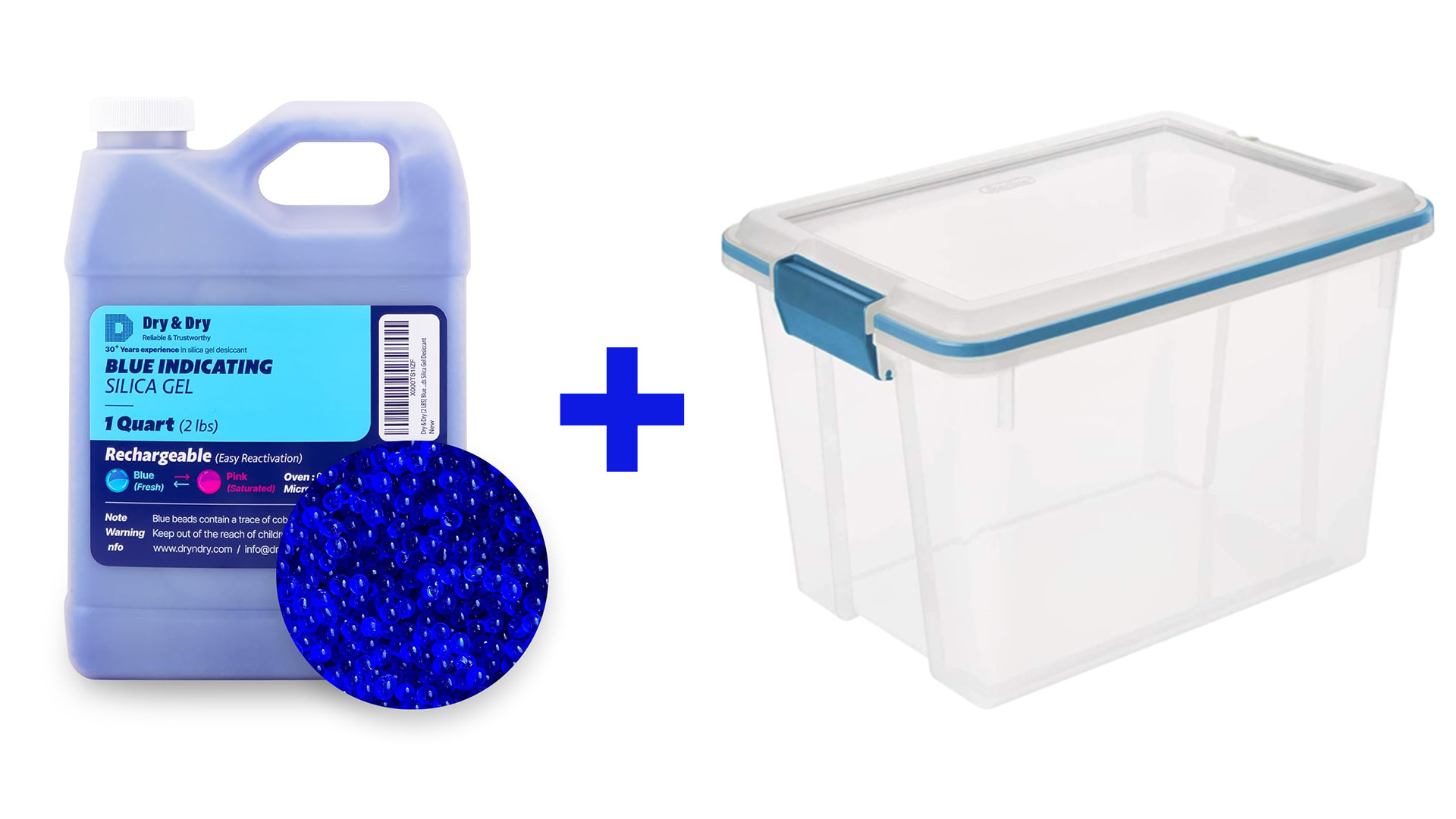
Sterilite 20 Qt Gasket Boxes (6-Pack)
Moisture is one of the biggest enemies of quality 3D prints. These dry boxes are game-changers for filament storage. Each box holds 4 spools and features a gasket seal that helps keep your filament dry and ready to print.
The rubber gasket creates an airtight seal when you clamp the latches, blocking humid air from reaching your filament. The clear base lets you see exactly what's stored inside without opening the lid (which would let moisture in). And they stack neatly, so your filament collection stays organized even as it grows.
With this 6-pack, you can properly store up to 24 spools, keeping your entire filament collection in optimal condition. At around $50-60 for six containers, it's a fraction of what commercial filament storage solutions cost.
Reusable Silica Desiccants
Dry & Dry Indicating Silica Gel Beads
To complete your filament storage system, you'll need reusable silica gel desiccants for your dry boxes. While the airtight seal prevents new moisture from entering, desiccant actively pulls existing humidity out of the air inside the container.
Plan on using about 1 pound per dry box for optimal moisture absorption.
What makes these particularly great is their reusability: they turn from blue to pink when they've absorbed moisture, and you can simply place them in the oven for a few hours to dry them out. Once dry, they return to a bright blue color and are ready to use again.
This means you'll never need to buy desiccants again, making them both cost-effective and environmentally friendly. A single purchase lasts essentially forever.
How Much Desiccant Do You Need?
For a full 6-box setup storing 24 spools, here's my recommendation:
- 6 lbs active – One pound in each dry box
- 2 lbs rotating – Currently being dried or stored dry as backup
The Dry & Dry silica gel comes in various sizes. For this setup, the 8 lb jug is the sweet spot—enough to fill all your boxes plus have reserves for rotation.
Setting Up Your Dry Storage System
Step 1: Prep the containers
Wipe down your Sterilite gasket boxes to remove any dust. Make sure the rubber gaskets are properly seated in the lids.
Step 2: Prepare the desiccant
Place about 1 pound of silica gel beads into a breathable container for each box. Options include:
- Dumping it straight in the bottom of the tub
- Printing a dessicant holder that sits in the bottom of the tub
- Mesh bags or organzier pouches
- Muslin fabric bags
- Even a clean sock works in a pinch
The container needs to be breathable so the desiccant can absorb moisture from the air inside the box.
Step 3: Load your filament
Stack up to 4 spools per container. I organize by material type—one box for PLA, one for PETG, etc.—but organize however makes sense for your workflow.
Step 4: Seal and store
Clamp the latches firmly to engage the gasket seal. Stack your boxes and store them somewhere out of direct sunlight.
That's it... Your filament is now protected!
The Regeneration Cycle
The beauty of indicating silica gel is you always know when it needs attention. Fresh desiccant is bright blue. As it absorbs moisture, it gradually shifts toward pink.
When to regenerate: The beads are about 50-60% saturated when they change color, so they're still working—but it's a good time to swap them out.
How to regenerate:
- Remove the saturated (pink) desiccant from your dry box
- Replace with fresh dry desiccant from your reserve
- Spread the saturated beads on a baking sheet
- Bake at 200-250°F for 30 minutes to 2 hours (check periodically)
- When they're bright blue again, they're ready
- Store regenerated desiccant in airtight containers (I use large mason jars) until needed
Alternative method: Microwave on defrost mode for about 10 minutes, checking frequently.
With 2 pounds in rotation, you'll always have dry desiccant ready to swap in without leaving any of your filament boxes unprotected.
Why This Beats the Alternatives
Vs. leaving filament in original packaging: Those bags aren't truly airtight, and the tiny desiccant packets included are exhausted within days of opening.
Vs. commercial filament dry boxes: Purpose-built solutions typically hold 1-2 spools and cost $30-50 each. For 24-spool capacity, you'd spend $300-600+. This DIY setup costs under $100.
Vs. vacuum sealing: Effective but inconvenient. You have to re-seal after every use, and the bags eventually fail. This system is open-and-close simple.
Vs. drying before each print: Filament dryers work, but they take 4-6+ hours per spool. If your filament is stored dry, you skip this step entirely.
Complete Setup Cost
| Item | Price |
|---|---|
| Sterilite 20 Qt Gasket Box 6-Pack | ~$55 |
| Dry & Dry Silica Gel 8 lb | ~$35 |
| Hygrometer 6-Pack | ~$8 |
| Total | ~$98 |
Under $100 for a system that stores 24 spools and lasts indefinitely. The desiccant never wears out—just regenerate and reuse.
Tips for Long-Term Success
Drop a Mini Hygrometer in each tub. The desiccant changes colors but a hygrometer gives you an accurrate humidity reading inside each tub. You can get a 6-pack of hygrometers here.
Check desiccant monthly at first. Until you know how quickly it saturates in your environment, peek at the color regularly. In humid climates, you may need to regenerate more often.
New filament goes straight into storage. Don't leave spools sitting out "just for a few days." Get them sealed up immediately.
Keep one spool on the printer, the rest stored. Only have out what you're actively using.
Store in a cool area if possible. Heat doesn't directly harm stored filament, but cooler storage means less moisture movement overall.
The Bottom Line
Moisture-free filament means fewer printing failures, better layer adhesion, and overall higher quality prints. This simple two-part system—airtight gasket boxes plus reusable indicating desiccant—keeps your entire filament collection in optimal condition for under $100.
Set it up once, regenerate the desiccant occasionally, and never worry about wet filament again.